
(OLEMISS) OXFORD, Miss. – A University of Mississippi doctoral student is studying whether microbes – like those found in yogurt and kombucha – could help turn moon soil into building materials for a lunar habitat.
Abigail Boateng, a doctoral student in biology from Ghana, received a Future Investigators in NASA Earth and Space Science and Technology award to study how microbial communities might help humans extract resources from the moon and Mars to aid long term space missions.
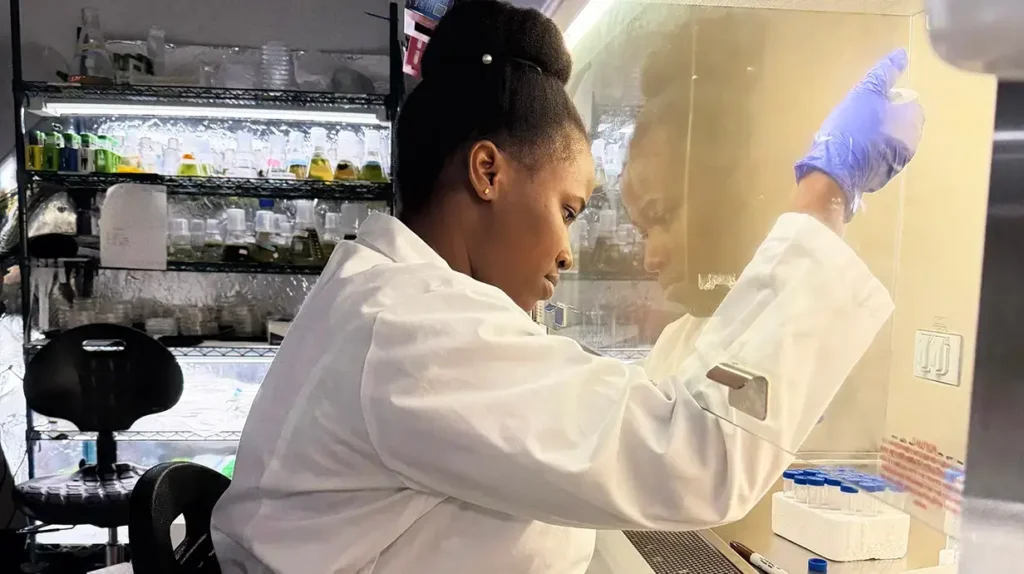
“NASA and other space agencies are planning to send humans to the moon for a long stay as a stepping-stone to Mars,” Boateng said. “That means we need to be able to use the resources that are already there, because it’s very expensive sending things from Earth to space.
“My research tries to use microbes from plants to extract metals for construction on the moon and Mars.”
Boateng is the first Ole Miss student to receive the competitive award, said Becks Prescott, assistant professor of biology and head of the university’s Microbial Interactions in Sustainability and Astrobiology lab. The program supports graduate students conducting research aligned with NASA’s scientific priorities and will fund Boateng’s study through 2029.
“This is one of the most competitive graduate awards in the country,” Prescott said. “She’s been working all summer in Hawai’i, she’s doing work here at the University of Mississippi, she’s going to be working at Pacific Northwest National Laboratory for a few months and she’s collaborating with private industries like AI Space Factory.
“That’s work in the academic space, a national lab and in the private sector. The goal was to give her experience in all three of the areas that scientists tend to work in so that when she’s ready for her career, she knows exactly what she wants.”
Creating building materials and other supplies from resources available on other planets will be key to long-term human settlements on the moon and Mars. Boateng’s project could turn waste from other operations on a lunar or Martian base into tools for infrastructure.
“Of course, we’ll have to grow our own food there,” she said. “But most of the plant after the food is grown will become waste. Why don’t we harness the potential of microbes in plant waste to extract metals from regolith?”
Microbes are tiny living things such as bacteria, viruses or some fungi. They naturally live on and in plants and help break down organic material.
“Microbes have been using fermentation pathways since before there was oxygen on Earth,” Prescott said. “Fungi and bacteria do this for us all the time; they’re even in our gut, where they help break down food.
“What Abigail’s doing is certainly not like kombucha, but it is using similar pathways to break down material.”